Which Log Parser Should You Actually Use?
Early in 2025 I took a freelance contract with a deceptively simple brief: a system was producing more logs than anyone could read, and someone had to decide how to make sense of them automatically. The interesting part is that most of the decision sits upstream of where people usually look. Before you can flag a single anomaly you have to turn raw log lines into clean templates, and the parser you pick quietly sets the ceiling for everything downstream. So I did the honest thing and benchmarked the options properly, going from a survey of the methods to a recommendation backed by numbers.
Freelance / contract work, early 2025. Everything below is about open-source algorithms on public benchmark datasets, with no client data or systems described.
Before You Can Detect Anything, You Have to Parse
Logs are the exhaust of running software: semi-structured text, often the only record of what a system actually did. But raw log lines are a mix of two things: a fixed template and the variable parts that change every time.
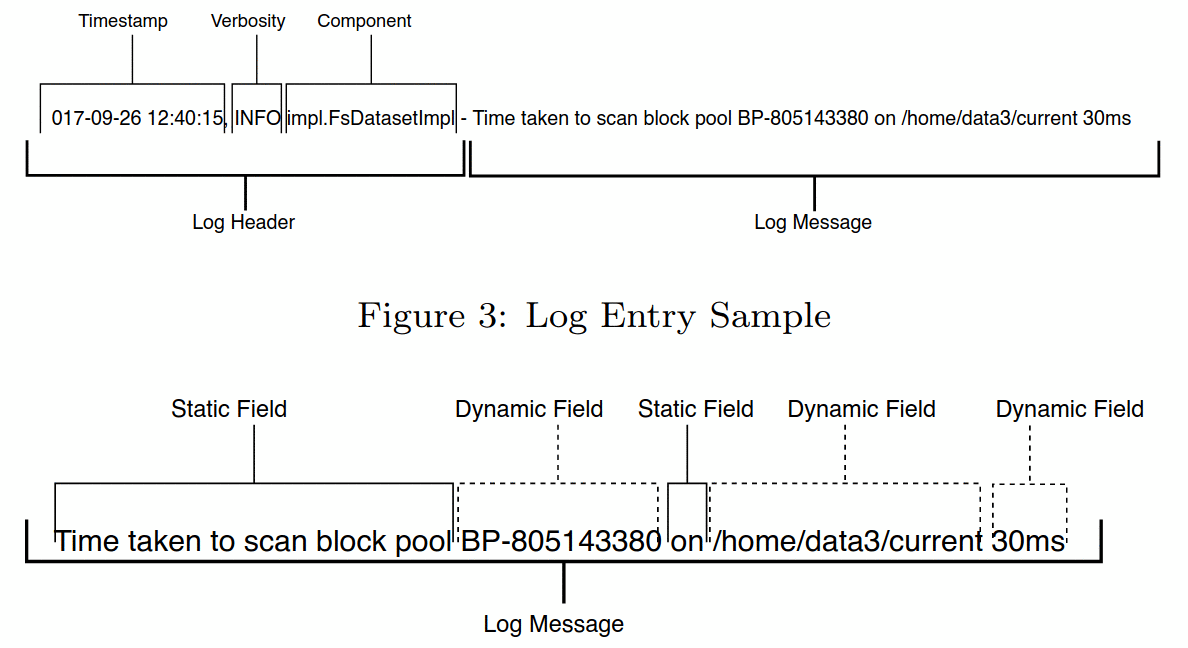 A single log line splits into a header (timestamp, level, component) and a message, and the message itself into static fields (the template) and dynamic ones (the parameters). Diagram from El-Masri et al. (2020).
Log parsing is the job of recovering that template: turning Connection to node-42 closed after 30ms into Connection to <*> closed after <*>ms. Everything downstream, from anomaly detection to failure prediction to root-cause analysis, depends on it. Get parsing wrong and no clever detector further down the line can save you.
So the real first question wasn’t “which anomaly detector?” It was “which parser?”
Studying the Landscape
Log parsing turns out to be a small field with a dozen genuinely different ideas. Before benchmarking anything I mapped the approaches, because the design philosophy tells you a lot about where each one will break:
- Fixed-depth tree (Drain): stream logs through a shallow parse tree with a cache. Fast, online, boringly reliable.
- Streaming with longest-common-subsequence (Spell): compare each new line against known templates by LCS.
- Iterative partitioning (IPLoM): split logs by length, then token position, then bijection.
- n-gram dictionaries (Logram): count token n-grams; anything frequent is template.
- Evolutionary search (MoLFI): frame parsing as multi-objective optimisation and search with a genetic algorithm.
- Clustering (LogSig, LogMine, SHISO): group similar lines, then abstract each cluster.
- Heuristics (AEL), and a bidirectional parallel tree (Brain) built around the longest common patterns.
One unglamorous but important filter at this stage was licensing: several parsers are GPL, which rules them out of a commercial product regardless of how well they score. That screen quietly removed a few candidates before a single benchmark ran.
The Benchmark
I built a harness to run 13 parsers over the public LogHub datasets (HDFS and friends) and score them on the axes that actually matter in production, not just accuracy:
- Accuracy and F1 on template extraction
- Throughput (MB/s) and memory usage
- Memory-to-file ratio: memory consumed relative to input size
- Parameter count: a proxy for how much tuning each one needs
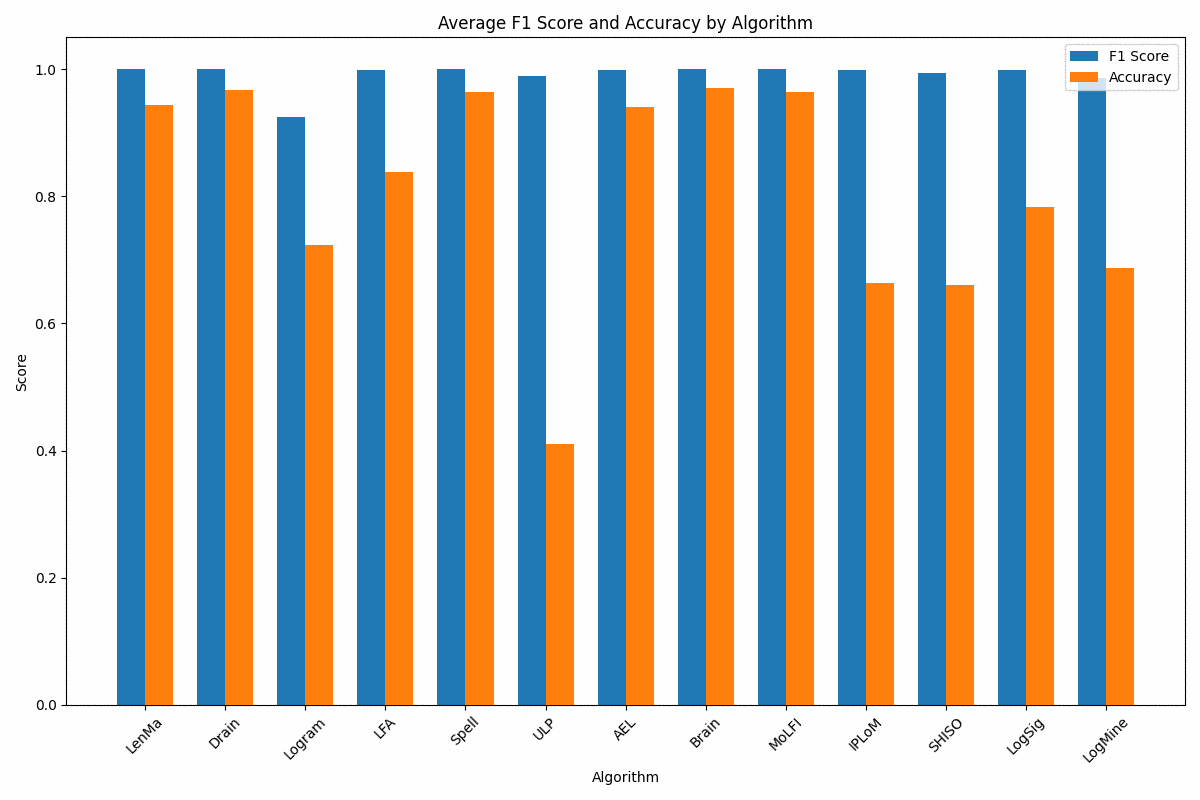 F1 is high almost everywhere (>0.98), but accuracy is where the algorithms separate. A high F1 with low accuracy means an algorithm is producing plausible-looking but imprecise templates.
The most useful thing the benchmark surfaced is that F1 hides the differences. Nearly every parser clears 0.98 F1, so on that number alone they look interchangeable. Accuracy tells the real story:
- Drain is the boring winner: 0.97 accuracy, decent speed, modest memory. If you deploy one parser and stop thinking about it, deploy this.
- Brain is the most accurate (0.971) but pays for it in memory (3× the lean options).
- Logram is the speed demon (3.1 MB/s, ~3× the pack) but trades away accuracy (0.72).
- LenMa is quietly excellent when resources are tight: high accuracy, lowest memory, a single parameter.
- ULP is the cautionary tale: good F1, but accuracy of 0.41. It confidently produces the wrong templates.
I ended up recommending five complementary parsers rather than one, so the choice could follow the constraint: Drain as the default, Logram when speed dominates, LenMa for constrained environments, Spell for streaming, AEL for high-volume-with-accuracy.
The Second Half: Anomaly Detection
With logs turned into structured templates, the features you feed a detector are largely categorical and high-dimensional: which template fired, in what sequence, how often. The engagement’s second track was choosing an anomaly-detection method for exactly that kind of data.
The existing benchmark supported five detectors. I extended it to 49, the full family of PyOD algorithms that inherit from its base detector, spanning classical methods (Isolation Forest, LOF, One-Class SVM, HBOS), deep models (autoencoders, DeepSVDD), ensembles, and GAN-based detectors. Making that many algorithms comparable meant more harness than model:
- per-algorithm memory tracking, because a detector that needs 30 GB is a non-starter no matter its AUC;
- dimensionality reduction (MCA for the categorical features, then UMAP) to actually see the structure and the outliers rather than trusting a score blindly;
- YAML-driven configuration and comparative ranking, so adding an algorithm was a config entry, not a code change.
What I Took Away
- The parser matters more than the detector. A sloppy template upstream poisons everything downstream, and it’s the step people skip past.
- There is no single best algorithm, only best-for-a-constraint. Almost every “winner” here won on one axis and lost on another. The deliverable wasn’t an algorithm, it was a way to choose.
- The harness outlives the result. The reusable benchmark (memory tracking, license screening, config-driven runs, ranking) was worth more to the client than any one number in it, and it’s the part I’m still proud of.
- Boring wins. Drain, a shallow tree from 2017, quietly beat far fancier methods. That’s a lesson I’ve watched repeat in every domain since.